My White Rabbit for February’s Month of Softies

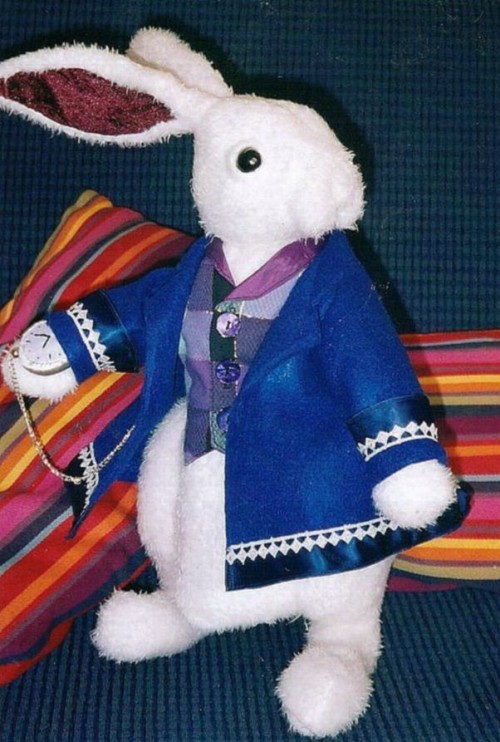
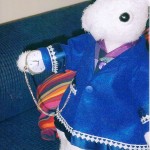
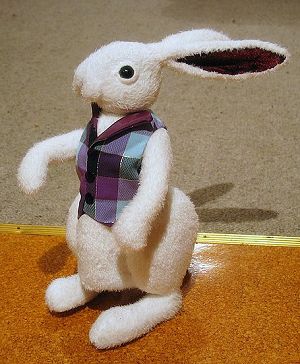
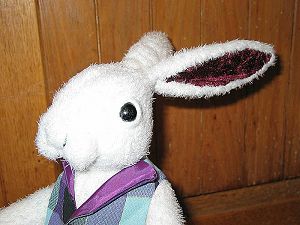
What a scramble – I forgot February was so short! But here is my White Rabbit for Loobylu’s Month of Softies, which this month was on the theme of Alice in Wonderland. He stands about 40 cm (15 in) tall, and is covered in a very soft kind of fluffy material, (I’m not sure what – its not fleece or
terry towelling). He was going to have a blue jacket and be holding a
pocket watch, but I ran out of time to make those today.

rabbitc

The rabbit is actually a very simple glove puppet, as he fits on your hand and you can turn his head with a rod inside his body. He is very cuddly, and its fun to cradle him your arms (without it being obvious that one arm is inside) and make him come alive.

rabbitd

Update: Here are some pictures of him now he is finished:

White Rabbit puppet

Mini book of Haeckel’s Art Forms of Nature

I’ve blogged about Ernst Haeckel before, but yesterday I picked up such a cool little book: a mini version of Art Forms of Nature, published by Prestel. Its only 12cm x 9cm, and has 25 plates of his drawings. Of course at that scale you lose something, and I would still love to have the large format version, but its still very satisfactory. There is a range of Prestel Mini art books, by the way.

Lord of the Rings Exhibition at the Powerhouse

The Powerhouse Museum in Sydney is hosting a great exhibition to do with how Lord of the Rings Motion Picture Trilogy was created. Its been running since late December, and will close on April 3rd.

There is a lot to see: props, jewellery, weaponry, armour, costumes, models, artefacts, design drawings and paintings, marquettes, moulds, the Ring itself, and prosthetics. There is also a swag of video coverage about how the digital effects, special effects and make-up were achieved, and video interviews with cast and crew, though a lot of that already appears on the extended DVD.

I’m not a great fan of Lord of the Rings. Its unrelentingly male, and I’ve always appreciated the joke that Shelob is the most convincing female character. But there was lots to enjoy about the films, and this exhibition. My overwhelming impression was how wonderfully detailed everything was, and how much thought and care had been given to its making.

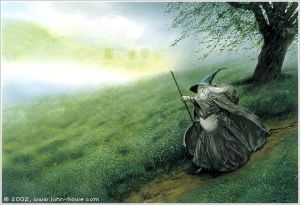
Gandalf’s grey robe is made of a beautiful rough mixture of natural fibres, (linen, hemp and silk, if I remember correctly) woven locally in NZ. I got a buzz out of seeing his wonderful bent felt hat (after John Howe’s great illustrations) , as well as all his ancient tomes. And lying among them, the charming surprise of his toffee bag, a small drawstring leather pouch!
Gdf2

Gandalf the Grey (courtesy www.john-howe.com – cool site!) Despite being a real Cate Blanchett fan, I had been disappointed with how Galadriel’s character was written in the film. But her dress was stunningly beautiful, white and luminescent. In contrast, the vacant dark Ring Wraith’s costume had a real sense of foreboding about it.The jewellery, weapons and objects like sword sheaths and straps were beautifully crafted and decorated. It was fun to see Frodo’s mithril coat of mail, and actually handle samples of the chain mail that was painstakingly made for Gimli’s and other characters’ costumes.

There were reproduction models (specially made for the exhibition) of Treebeard’s head, the cave troll and a goblin, which were cool. I loved seeing the marquette of Shelob’s head, and finding out that she was modelled on a tunnel web spider that the Kiwi designer Christian Rivers found in his garden. Of the building or scene models, I particularly liked the ruined Hobbiton Mill.

From a maker’s point of view it would have been good to find out in more detail the exact process of how some of these things were made, and the materials that were used, but I guess that would be catering to too specialist an interest. I haven’t read The Making of the Lord of the Rings, but I doubt that would go to that level of detail either.

I hoped to be able to buy a postcard of Galadriel’s dress to send to a friend’s daughter, but the merchandise in the inevitable shop at the end was boring, just the usual stuff that has been around in shops anyway. You would think that it would have been worthwhile for both sellers and buyers to have some merchandise available that actually reflected the finer focus of the exhibition.

You are meant to book for the exhibition if you are not a member, though the crowds had dropped off when I saw it a few weeks ago, and it was easy to get in. If you decide to go, its worth considering a membership to the Powerhouse. We qualified for a ‘rural family’ membership which cost $2 more than entrance to the exhibition, and gives us other perks for the year ahead not only at the Powerhouse, but places like the National Gallery of Australia and Questacon.
Patchwork and white rabbits

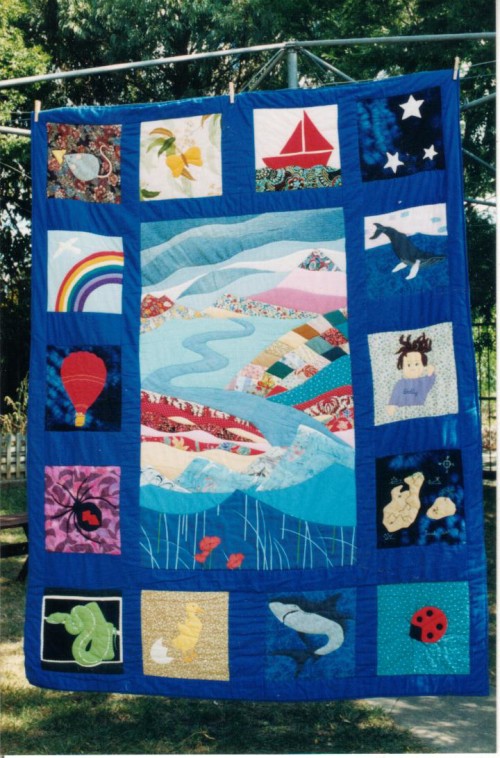
Finding Loobylu, and a very pleasant morning at Tilley’s last week, spent drinking coffee and sorting through a friend’s collection of fabrics, has made me dig out a picture of the quilt I made for my daughter about 8 years ago now. Its still loved and in use, but getting worn in places, particularly the blue-marbled silk that is in the wavy sea section of the middle panel.

quilt

I’m all enthused about Loobylu’s Month of Softies. The theme for February is ‘Alice in Wonderland’, and I’ve started making a white rabbit puppet!

A tentacle mechanism

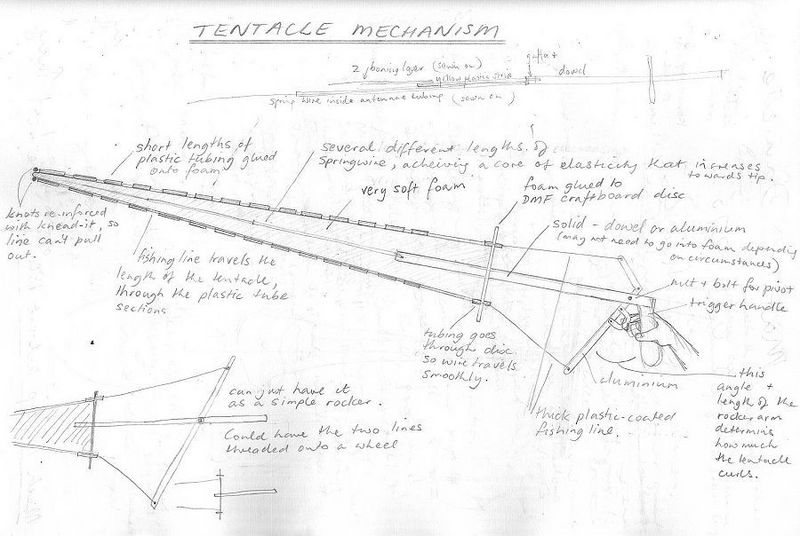
When I was making puppets for ‘The Lost Thing’ a few months ago we had to come up with a simply-made tentacle that could start out straight, and then reach about a metre or more, and curl around to some extent at the tip. Here is the drawing I made of the mechanism I invented, in case its useful to other makers:

Tentacle
(click to enlarge)
The tentacle shape is made of a very soft foam, and has two tracks of heavy duty fishing line running up each side, though small sections of plastic tubing. The kind of tubing I found good was antenna housing that model-car hobbyists use, because it is strong and rigid.When the fishing line is pulled the tentacle curls, and when it is released the foam itself acts as a kind of spring, returning the tentacle to an at-rest straight position. I did have to put some additional spring and rigidity in the core of the foam, though. It was an experimental mixture of different lengths of spring wire, boning and strip plastic, with the idea being to incrementally decrease the rigidity towards the tip. You have to balance aspects like having the foam soft enough to compress easily, and the core springy enough to return but not too rigid to bend easily, and so on.The tentacle was covered: a very thin layer of dacron batting to make it all smooth, and then lycra.

The curls in simple tentacles usually only work in two directions. They are mechanically similar to those intriguing flexible wooden snakes and fish whose bodies are sliced into lots of cross-sections, and then constructed again with a leather or canvass strip running up the middle of the body:

Snakecurl
A tentacle made like this moves from side to side, not up and down, or with any twisting. The thing that excited me about the foam tentacle was that by pulling on both lines with varying pressures, it would twist around in a very sinuous way. It was not a feature that could be used much in the play, as the puppeteer only had one hand free to operate the tentacle, but it was an interesting discovery. It would also be worth experimenting with trying three or four operating strings, if the base of the tentacle was in a firm housing rather than being hand-held.

The Vulva Puppet

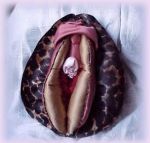
In honour of V-Day which proclaims Valentine’s Day as its own until violence against women stops, step over to Dorrie Lane’s gallery of Wonderous Vulva Puppets ™.

Hina

Each puppet is individually made using silk, satin and velvet; anatomically correct, and explicitly detailed; given a name inspired by goddesses or great female characters from folk lore or literature; decorated with hand beading and semi-precious stones; and infused with fragrant flowers and herbs. They are described as ‘an ideal gift for lovers, mothers, therapists and educators’.Update: It looks as if the gallery above is an old one, as there is a newer gallery, and a collection made from Vintage Versace Velvet. Also, the puppets are about baseball mit size!


A puppet production of ‘The Mousehole Cat’

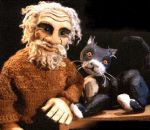
By chance I discovered that the British puppetry company Puppetcraft have done a puppet show of The Mousehole Cat, one of the books by Nicola Bayley that I mentioned in my previous post. These are their carved wooden puppets of the legendary Tom Bawcock and his cat,

Mousehole

who ‘saved the villagers of Mousehole from starvation by putting to sea in a fearsome gale on the day before Christmas eve and catching seven sorts of fish, enough for everyone to make and enjoy a life-saving, local delicacy – starry gazey pie’. The pictures and reviews on their site, make it look like a great production, and they have a recipe for starry gazey pie, too. Apparently Tom Bawcock’s Eve is still celebrated in Mousehole on December 23rd each year.

Calendars, Georgia O’Keefe, and Nicola Bayley

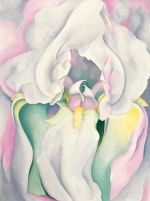
This year I ordered a Georgia O’Keefe 2005 Calendar online, having been a slowcoach and letting January slip by without getting a new calendar for the year. It arrived last Friday, and it’s beautiful:

Iris1_1

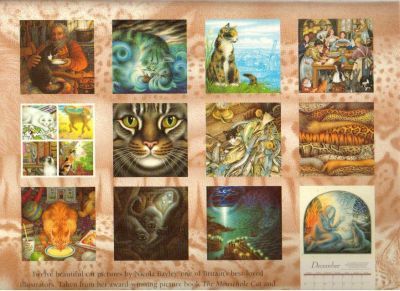
I do love her paintings, particularly her later more abstract landscapes.I used to like getting a UNICEF wall calendar each year, the kind that has drawings done by children from all over the world, but they were all gone. So was everything except dog or cat breed calendars, and even for half-price, and if I were obsessed with siamese cats, I don’t want to look at everyday siamese cat photographs all year. In fact I’ve never really understood why so many calendars have so little visual variety, except that I suspect they provide an easy avenue for Christmas shoppers, who can think ‘Oh, Auntie Mary loves cats, this will do for her’.Calendars that feature artistic interpretations of a single topic stand a better chance of being interesting, as long as you particularly like the style in which they are done, or there is some variation of style in the 12 illustrations. For example, in 2003 I had a calendar I loved, a cat calendar by Nicola Bayley. Its selection includes drawings from Bayley’s books The Necessary Cat: A Celebration of Cats in Picture and Word, Fun with Mrs Thumb, Katje, the Windmill Cat, and The Mousehole Cat, and although there are cats in all of them, and they all show Bayley’s exquisite attention to detail and the decorative, they tell so many different stories.

Bayley2

Nicola Bayley’s drawings have been a favourite of mine since my children were small; we had two of her books: The Mouldy, and The Patchwork Cat (written by William Mayne). When I was the illustrator for the Republic of Pemberley in the 90’s, the cat drawing that I did for the Portrait of our Community board was inspired by those in The Patchwork Cat.