March’s Month of Softies

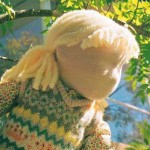
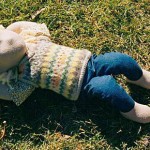
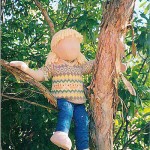
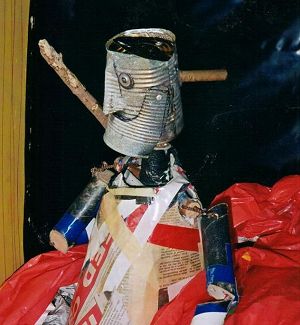
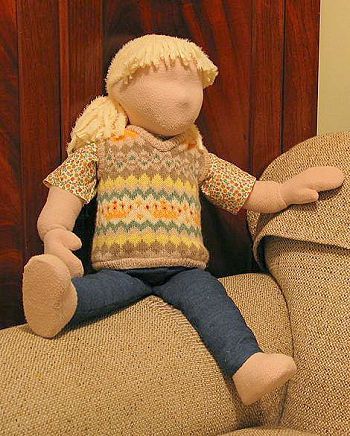
Scrambling under the wire again… this is my entry for Loobylu’s Month of Softies for March. The theme was self-portrait of the artist as a young child.

sd2

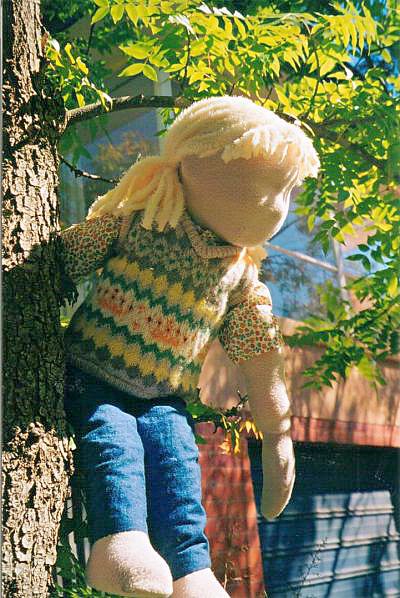
I can’t say it looks very like me, but the essentials are there – round face, blonde hair, button nose, tom-boy. The Fair-isle vest is made from an an unfinished jumper that I rediscovered when I was rummaging for fabric. I knitted it years ago in Scotland and I had completely forgotten about it. The vest is a kind of present to myself, because when I was young one of my aunts made stripy vests out of odds and ends of wool for my brother, and I always fancied one for myself.

Update: I took some better daytime photos yesterday, much better than the midnight one.

Tree climbing


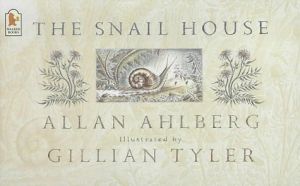
‘The Snail House’ by Allan Ahlberg

The Stop Laughing This Is Serious Gallery in Blackheath ran a great exhibition of puppetry-related works during One Van, which I hope to get around to blogging about sooner or later. But they also had a small but interesting range of books, and I have been kicking myself for not buying one called ‘The Snail House’, by Allan Ahlberg, as its not generally available in bookshops here.

I’ve always loved Ahlberg’s picture books (‘Peepo!’, ‘The Jolly Postman’, ‘Each Peach Pear Plum’, (all illustrated by Janet Ahlberg, his wife) and ‘Mrs Plug the Plumber’ were favourites in our house), so ‘The Snail House’ caught my attention anyway, but its an absolutely beautiful picture book. Its about a grandmother telling her grandchildren a story about how they shrink until they are small enough to go travelling in the house on a snail’s back, and the adventures
they have.
Snailhouse1

Its charming in so many ways. The adventures are everyday, and yet exciting; for example, an apple falls next to them and it seems like an earthquake or bomb. It has all the joys of contemplating life in different scales and microcosms. The illustrations, by Gillian Tyler, are finely drawn and textured, with lovely soft muted colours, and I’m sure they have lots of secrets in them to spot, as Ahlberg books do. Most intriguing is the manner of the telling: its written so you can see the grandmother reacting and adjusting her story as the kids react imaginatively to what she is saying, just as it happens
in real life.

I like the humour, lightness, and modesty that comes across in interviews with Ahlberg, such as in this one with his readers, or when talking about his poetry (I hadn’t realized he had published verse). Penguin UK’s listing of him as one of their authors goes some way to describing the vitality and connection that must have existed both professionally and personally between him and his wife Janet, who illustrated many of the books. That ‘process of playing table tennis’ with ideas, jokes and visuals is a heady creative experience! Janet died in 1994, but it looks as if their daughter Jessica shares the family talent, as last year she illustrated her father’s book, ‘Half a Pig’.

Its interesting Janet and Allan Ahlberg are the subject of one of a series of books about famous people by Heinemann Library, along with others like Nelson Mandela, Mozart, Ford, and Disney.
Happy World Puppetry Day

Though its not widely known, March 21st is World Puppetry Day! Dario Fo, who won the Nobel Prize for Literature in 1997, released a WPD message through Union Internationale de la Marionnette, (UNIMA), which you can read on the Unima Australia website.

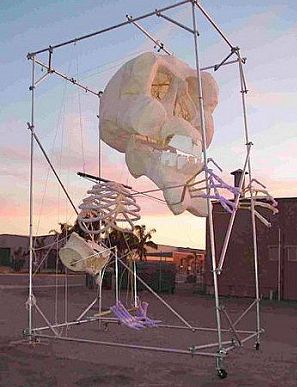
It was rumoured that this wonderful six metre tall Mexican skeleton puppet (made by Karen Hethey and Bryan Woltjen), which was part of the Joondalup Festival parade in WA last Saturday, was likely to make surprise appearances today in celebration of World Puppetry Day.

Muckheap

‘Muckheap’ by Melbourne’s Polyglot Puppet Theatre was another favourite of mine at One Van in January. Described as ‘a galloping tale of two people who try to clean out their shed for hard rubbish day but find everything too interesting or full of memories to throw out’, it also weaves in a different version of Jack(y) and the Beanstalk, ideas about recycling, play, and memory, and an inventive mix of puppetry and scale. The puppets were designed by Paul Newcombe, and adapted and made by Graeme Davis. Here is one of them:

Muck2

The relationship between the two main characters was pleasing in the way it ranged from tension and teasing to fun and fondness. I also liked the way it showed imaginative play and puppets as being able to be made out of anything. (The only thing that the actors deemed unable to be worth keeping at the particular performance I saw was a John Howard poster). Its good news that ‘Muckheap’ will be coming to Canberra in May as a Jigsaw Theatre Company ACT Schools Tour, and later in the year it travels to Queensland.

Hooray for two-dollar shops!

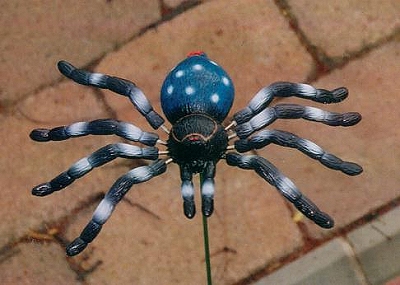
Tacky but interesting: this is a huge spider garden spike that I got at the $2 shop the other day. It’s a hand span across, and the connections between its legs and body are fine springs, so that when the spike is jolted the legs have an incidental movement. The best movement you can get out of it is a kind of drumming of the legs, where, on each side, legs 1 and 3 are in sync with each other, and legs 2 and 4 are doing the opposite. Then it has the right kind of action for a huntsman spider.

Spider3

I have a couple of other insect garden spikes, a bee and a dragonfly (bought out of curiosity when I was working on making giant bees and dragonflies a few years ago). They are much smaller than the spider, with bodies about 7 cm long, and the wings are on double springs. The dragonfly has much lighter springs, and a much better incidental movement than the poor bee, whose springs and wings are way too heavy.

Jonathon Oxlade

For me Jonathon Oxlade was the stand-out performance of the One Van puppetry festival in late January. His short performance during the Saturday night cabaret was exciting, bizarre, gross, and hilarious. Jonathon works as a freelance theatre designer, illustrator and puppeteer.

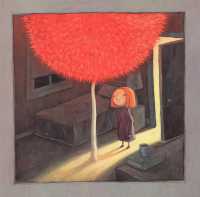
According to his bio, among many other things, he created The Red Tree installation — ‘an interactive experience full of little surprises for the eyes, ears,heart and mind’ — that accompanied the QPAC’s Out of the Box production of ShaunTan’s beautiful picture book ‘The Red Tree’ in 2004.

Redtree

This year he is designing ‘Creche and Burn’ (on stage in April) and ‘The Dance of Jeramiah’ (in Oct-Nov) for LaBoite Theatre, and a production of the Dicken’s classic ‘A Christmas Carol’ for the Queensland Theatre Company late in the year. He is currently working on a picture book, too.

Interior grip design for foam puppet mouths

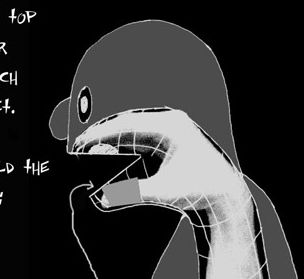
At Transformed Puppet, puppeteer and artist Ronald Binion has an excellent page about issues to do with making the interior of a foam puppet mouth both comfortable and effective in manipulation. He illustrates the kind of hand grips that he prefers.

Grip

As he notes, the interior is just as important as the exterior aesthetics in terms of using the puppet expressively; and as there is a propensity for puppeteers to suffer from repetitive strain injuries in the long run, it is also an occupational health issue that puppet makers have to keep in mind. Binion is also right in suggesting that there are many solutions to the problem. One of the joys of puppet making is that it is about problem solving, and individual approaches are valuable and part of the art. I particularly like the look of the thumb tube that is ‘connected to the mouth plate at only one point, allowing the thumb tube to act as a lever, and not force the thumb to conform to the angle of the mouth plate’. It’s also vital that the hinge of the mouth fits snugly into the hinge of your hand, between your thumb and fingers.

Take a tour around the Transformed Puppet (updated link 2015); there are some interesting puppet pictures and productions there. (Via PuppetVision Blog)


Olavi Lanu’s ‘Reclining figure’ sculpture

This is a dawn picture of one of my favourite sculptures in Canberra, on Ellery Crescent outside the School of Art. Its by a Finnish artist, Olavi Lanu, and was made in 1982.

You can see it enlarged and from a few different angles here.

At first I really did think it was group of real granite boulders that just happened to look like a person sleeping. I like imagining that rocks or mountains are slumbering spirits that sometimes might stretch and come alive to go about their business when no-one is about. Of course there are lots of stories along those lines; the ancient stone creature in Patricia Wrightson’s children’s book The Nargun and the Stars comes to mind.

But Lanu’s reclining figure is made from fibreglass resin, presumably on a wire form. Apparently it was originally covered with moss, but over the years lichens have taken over. There is another figure by Lanu not far away, but sitting among some trees.