Month of Softies: May Flowers

The theme for Month of Softies this month was ‘May Flowers’. My first thought was of daffodils, as I remember loving how they came up all over the place in lawns in the chilly spring in York and Cambridge; and I thought I might try to make Talitha, the brave daffodil princess from the book ‘The Mouldy’ by William Mayne, and illustrated by Nicola Bayley:
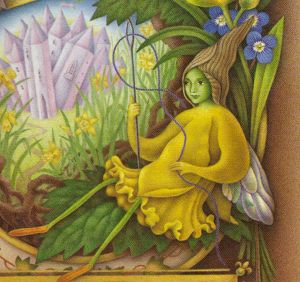
talitha

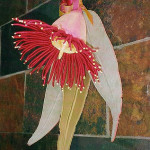
Then I decided to consider Australian May flowers. There isn’t much flowering here in May, except some irises which usually flower in July, but this year are muddled by our late winter and drought. But there are a few winter-flowering eucalypt trees, so I started planning a red gumnut flower fairy. I thought the stamens could make a kind of drop skirt, or hat fringe, but in the end decided that I liked the flower just as a flower.
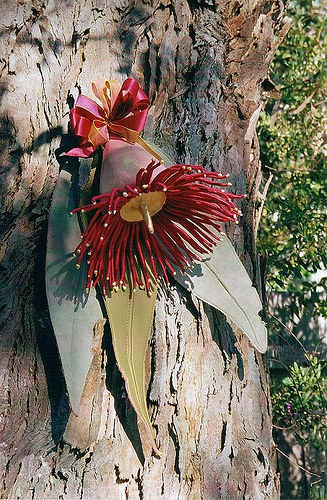
Red flowering gum-2

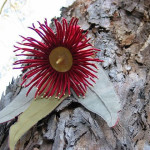
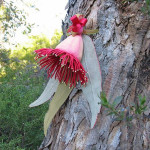
Its quite big; including the leaves it measures just over 40cm (16in). For the stamens I used lycra, an idea that I had previously found worked well for making small octopus tentacles! I like the soft colours, too. There are few more pictures:
 

‘The Lost Thing’ to become a short film

LtboyHaving made puppets for a theatre production of Shaun Tan’s ‘The Lost Thing’ last year, I was excited to find out that Passion Pictures is making a short CG film of the book. It will be fun to keep an eye on their gallery of pictures of work in progress over the next months. Among the images there at the moment are drawings of some of the utopian lost things. There were only five utopian lost things in the theatre production, so it will be great if we get to see more of them brought to life in the film. There are also images of a sculpture of the boy by Ron Mueck Mueck, that will be used for mapping the boy from all angles into the CG program. How cool is that!

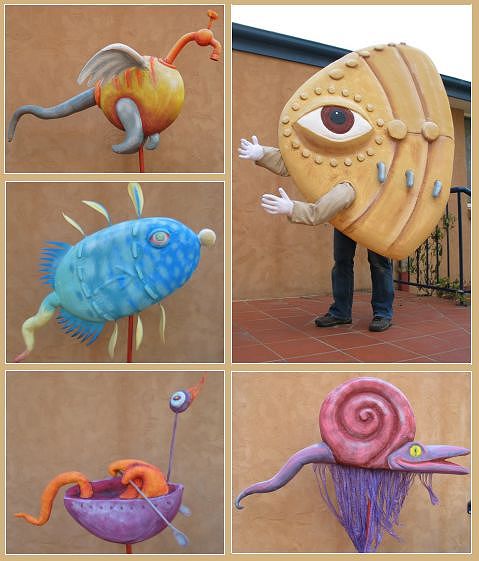
Snuff Puppets: Nyet Nyet’s Picnic

I wish I could be in Melbourne this weekend for Snuff Puppets‘ latest production, Nyet Nyet’s Picnic, which starts on Friday at Birrarung Marr on the banks of the Yarra.

In a collaboration between indigenous and non-indigenous artists, Nyet Nyet’s Picnic is a contemporary work that revives ancient stories from the dreamtime, and uses giant puppets, dance, and music in an exploration of local monsters, bunyips and spirit creatures. Described as a ‘genuinely scary, culturally enlightening and engaging night of theatre’, the performance is the cultural highlight of Reconciliation Week and is free to the public.

The photo above was taken by Ponch Hawkes, and there are three others here:
The Nyet Nyet Women
One of the Nyet Nyet Woman
The Nyet Nyet Men

UNIMA 2008 Logo Competition

The deadline for the Unima 2008 logo competition has been extended to accommodate Tafe and other educational institution courses. The due date is now July 22nd, 2005. Details are otherwise as outlined here. Go to it!

The Unima congress and festival is held every four years, and in 2008 it is being held in Perth, WA. This is exciting, as it is the first time it is being held in the southern hemisphere. It encompasses a ten day international festival of puppetry, a conference, and the Congress of UNIMA where the Executives and Councillors from throughout the world meet to discuss organizational and artform issues.

If you are not familiar with Unima, it stands for ‘Union Internationale de la Marionnette, and it’s ‘an international organisation bringing together people from around the world to contribute to the development of the art of puppetry, and to use it in the pursuit of human values such as peace and mutual understanding between peoples’. Here’s the Australian branch site.

Making of Nature Band Parade Puppets

Over at Puppetry Australia, Sean Manners has put together a pictorial account of the building of the parade puppets for Nature Band, a community puppet project that ran as part of the One Van Puppetry Festival earlier in the year, held in Blackheath in the Blue Mountains out of Sydney. The puppets, five yellow-tailed black cockatoos, four trees and three
waratahs, were made by participants in community workshops that were held over several months.

‘The puppets were initially designed by Jenny Kee; realized by Paula Martin, a local designer and sculptor; the workshops were facilitated by Sean Manners, puppeteer and community artist; and the performance and project as a whole was directed and choreographed by Sue Wallace of Sydney Puppet Theatre.’

The Victory Theatre Cafe and Antique Centre in Blackheath has a cool community mural along one side, that surely must also have been designed by Kenny Kee:

There is also a bus shelter on the edge of Blackheath that I liked because it has been painted to celebrate the puppetry festival (click on the thumbnails for larger images):

'One Van' Bus stop mural

I heard the distinctive yellow-tailed black cockatoo calls when I was in Blackheath. They are wonderful birds, quite big – about 60cm – and I always feel its a good omen when they are about, though their calls are somewhat plaintive. In Canberra it used to be quite rare to see these cockatoos, but since the devastating bushfires in January 2003 they have moved into the suburbs. A few weeks ago, we had the first ones in our garden. They spent several hours ripping the bark and branches of a dying gum tree to bits in search of borer insects.

Kamon&#233

Kamone1Oh yeah, the World EXPO also has a pavilion mascot, a platypus called Kamoné. She was designed by Melbourne-based illustrator, artist, toy designer and storyteller Nathan Jurevicius, best known for his Scarygirl series of toys, comics and products.
The drawings are pretty cool and there are various versions of her: dancing, just herself, in a long dress, playing soccer, with ipod and backpack, with tote and pencil, as an artist? (interestingly this isn’t used – maybe its not clear enough), and as a scientist.

There is also a bodysuit puppet of her. There are numerous pictures in the Australian Pavilion image gallery, such as this one of her supervising the unloading of the platypus exhibit (minus her gloves). And here Kamoné is at Tokyo Station, meeting her friends the official Aichi Expo mascots, Kiccoro and Morizo, a forest child and a forest grandfather.

One other thing. There is nice flash graphic at EXPO2005, though its a pity you have to scroll down to get both images.

The Making of the EXPO Giant Platypus

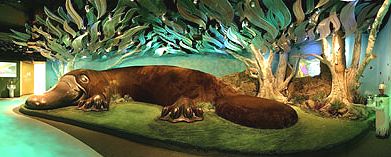
You might have seen pictures in the news of the Prime Minister and his wife dwarfed by a giant platypus, on the occasion of the opening of the Australian Pavilion at the World Expo in Aichi, Japan a couple of weeks ago. It was made by a team assembled by the Melbourne production company, think!OTS, and there are some images of the platypus there, if you check their portfolios.

Expox

Yesterday I was delighted to also find photos of the making of the platypus exhibit at Australia at Aichi World Expo 2005 in their Pavilion Photo Gallery. Starting with an artist’s impression, they move on to show how the over-all shape was constructed out of foam, filled with plaster, coated with concrete and covered with leather and soft fur. It’s not clear to me from that description how they end up with hollow sections, but I’m guessing that its the concrete layer that forms the shell. The platypus measures about 11 metres.Here are a few other picture links:

‘Our Mary’ and Prince Frederick with the platypus
‘Our Mary’ sits on its tail
Mr and Mrs Howard with the platypus: 1,2 (both photos by Penny Bradfield)
Update: Platy-cam! (not available anymore)

Little Golden Books: Tibor Gergely

The following illustration is by Tibor Gergely from the Little Golden Book ‘Houses’ by Elsa Jane Werner. I’m posting it as a comparison to the one by Richard Scarry in another Little Golden Book, ‘Cars and Trucks’, over at Wee Wonderfuls. There is an interesting discussion there about how in updates of the book that particular illustration has been changed to accommodate a more feminist attitude to gender roles. This one obviously belongs firmly in the earlier era, and I wonder if it was changed in a similar way later on?

I don’t have an exact date for this book – its one of a set of four books that together make up a ‘Little Golden Book Library’ that I bought in about 1983, and the dates given collectively are 1948 through 1969.

I was interested to see in an online bio of Tibor Gergely that as a young man he worked for two years in a Vienna marionette theatre as a puppet designer and stage decorator :-).