The Magic of Marionettes by Anne Masson

I remembered yesterday that the tip about storing marionettes by twirling them so the strings twist up together (in the comments under my last post) came from a lovely book called The Magic of Marionettes by Anne Masson. It was given to one of my kids, but I got a great deal out of it too, not so much because it was about puppets, but because it is written with a real understanding of the delight and empowerment that creating and making something can give you.

The book covers how to make the puppets, how to put on a performance, write a simple play, and it discusses props, scenery, sound effects and scripts that might be used, while keeping lots of room for individual creativity, and emphasizing that the process is as important as the result.

Simple rods puppets from recycled materials

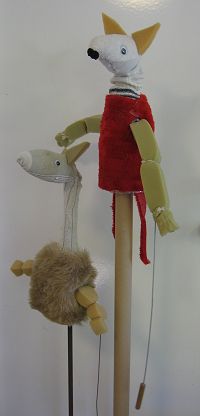
RodThese are two simple rod puppets which were made by my son when he was about 8, at a workshop that I was involved with.

The materials were recycled bits and pieces. The basic pattern was a plastic bottle for a body; a stuffed sock for the head; cardboard tubes running through the bottle neck for the neck, and for holding the puppet from below; strips of foam for the arms; wire rods for manipulating arms and hands; and odds and ends of fabric and other things (glitter, eyes, bobbles, straws, paper, offcuts of leather, ribbons and cord, and so on) for features and decoration.

The main preparation for the workshop, apart from collecting all the materials, was making the rods, though they were simple enough. They were a strong wire (it must not bend too readily), cut to size, straightened, anchored in a length of dowel at one end, and bent or hooked (so that could be poked into the foam at the wrist) at the other end. To fix the wire in the dowel, drill a hole down the centre of the dowel that the wire will fit in tightly, and then make a tiny bend in the wire a centimetre or so from the end before pushing it it. For this purpose the bend is enough of a barb to keep the wire in.

Craft glue was used to attach fabrics and foam, but we had a nifty way (I still think it’s nifty!) for the kids to attach the arms to the body: cut a X about 3 cm across into the plastic and just push the foam through. Again, the tension and points of plastic are enough to secure the foam. The elbows and wrists are made just with string tied tightly around the foam, but they are surprisingly effective.

I think the most important aspect when doing this kind of workshop (after providing basic ideas, materials, and help) is to leave the rest to the imagination of the makers, so that other ideas in construction, features, characters and the stories that inevitably emerge with them, are welcome and valued.

Simple rod puppets

Starting and finishing

I was thinking today about how we go about starting and finishing things. It’s kind of curious and fascinating, don’t you think? How do we decide exactly what to do first, and how do we know when to stop?

This was prompted because I’ve started a new project in the last few days. I’m making a large body suit, and it has some mechanisms that have already been made, which I have to integrate into it. It’s a one-off, no prototype, so nothing to really draw on, and I anticipate quite a lot of problem solving.

Although this character has been discussed and planned on paper for a while now, making a physical start feels like a challenge, and I’ve been circling it at a distance, and doing ‘busy work’ around it. It’s rather like when you see someone swirling their pen in the air a few times before actually being able to sign their name, or like a dog going round and round before being able to settle down to sleep. So today I have been to the fabric shop to see what is available, and I’ve measured things and had lots of cups of tea. And I fiddled with some parts of the mechanism which needed bulking out, because that was a fairly straightforward thing to do. Tomorrow I will make a small plasticine model to make a pattern from, and then after all this nibbling around the edges I can probably make a more convincing start.

In the past I’ve regarded this phase as procrastination, or just something silly I inevitably do, but today I have shifted and decided that instead it must be a necessary and positive part of the process.

Finishing is equally as interesting. In this case, though, the exact finish will likely be dictated by a deadline!

Taking the plunge

There ought to be a word for the reticence I feel about jumping back into the online world after some time away. It’s so strange, because I mostly love the online life, and I am brimful of things I want to blog about. So to break the ice, here is an early morning photo from the beach house bedroom at Encounter Bay, looking out to Wright Island, and Seal Rock in the distance to the left. The best thing about staying at Encounter Bay is rowing out to the island when no-one else is there. The one time I was able to do that these holidays, there were a few dolphins around the boat at one point: magic.

View to the island

(Click to enlarge)