Duck walks into a Bar

Duck

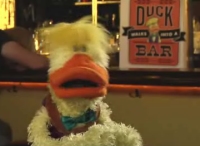
I also received a note about Duck walks into a Bar, a ‘bar-hopping, Muppet-style character who likes to troll bars in search of babes, booze and free drinks’, created by Kevin Susman & James Murray. It’s not particularly my taste, but the puppetry, character and video production are slick, so take a look.

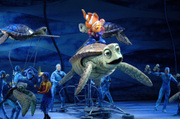
Finding Nemo: the Musical

Brian Kolm sent me a note a few weeks ago about Finding Nemo: the Musical, a new musical stage show at
Disney’s Animal Kingdom. (Thanks, Brian!). If you page down you can see photos of some of the large puppets, which seem impressive.

‘Principal characters such as Marlin, Nemo and Dory will be represented by live performers operating animated puppets. Some puppets are larger-than-life — such as Crush, the cool sea turtle, who is nearly the size of a Volkswagen, and Nigel the pelican, who stands 22 feet tall.


Other characters will be portrayed by a diverse array of puppetry styles, including rod, Bunraku and shadow. Tap dancing sharks, puppets riding bicycles, and a punk rock routine by Bruce the shark create theatrical magic and fun throughout the big blue world.

The Laughing Place has a couple of extra pictures in their two-page gallery.

The puppets have been designed by Michael Curry, who was the co-designer for The Lion King. The production opens officially in January 2007, but meanwhile preview shows have begun, and you can read a few reactions here.

Walk against Warming

Sunflower

The Fool Factory’s Sunflower gives a unusually taciturn glance at the Walk against Warming a couple of weekends ago. I also love this one of the Rat Patrol at Cutflat.

I’m missing blogging! Heaps of things to blog about and no time to do it, is the story. I figure as far as making work goes, I have to make hay while the sun shines. Hoping to get back to it more often in December when the play I am working on has made its run.

Gimme a head with hair…

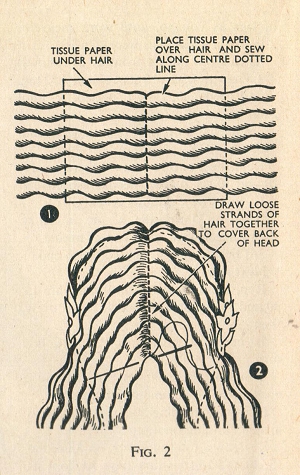
It’s nice to have Claire posting again at Loobylu. (Claire had a beautiful second baby girl recently – congratulations!). Her post today mentions the difficulties of making hair on dolls – I agree it is tricky, and depite the post title, I really don’t like dealing with hair at all! It jogged me to scan some drawings that I have found useful for hair making. They are from an old book we have called TOYS you can make yourself, published by Odhams Press Ltd, London, advisory editor Hilary Page. Other than that it has no copyright information, but I’d guess it’s from the late 40’s or 50’s.

In this first figure, the middle row of stitching is the parting of hair down the centre of the head. You make it as long as is needed to cover the head, and then draw back the hair into bunches or plaits or however you fancy and stitch them on.
Hair

I used this idea for the doll I made a while ago, but instead used an interesting kind of fabric. I always forget its name, but its something like ‘feathered velour’. I stitched it slightly gathered down the centre of the head, and then arranged it to look like strands of hair in bunches, and cut the ends to give it that effect, too. On a doll that size it was a lot easier and quicker than doing the wool
thing.

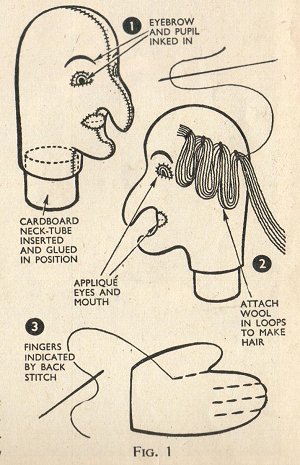
The next one shows making loops of hair. I guess you could cut the ends once the loops are sewn on.
Hair2

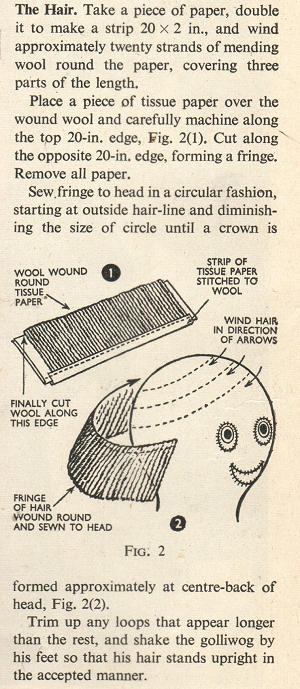
This one for gollywog hair is the one I have used most, not so much the circling attachment to the head which gives you the shock-headed hair, but the making of the hair by stitching it on doubled-over paper. It’s a bit like a flat pom-pom! Instead of circling, you can use it for rows around the side and back of the doll’s head, and for fringes.
Hair3

Giant cross-section flower

Cross-section flower

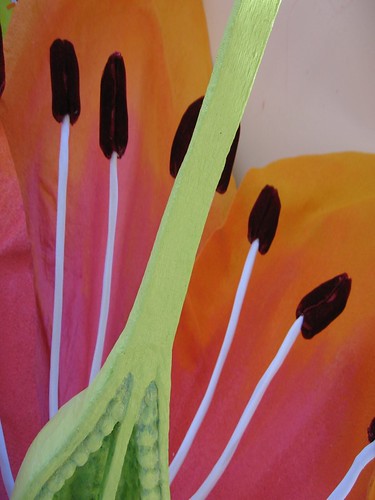
My third project for Floriade was making a giant model flower in cross-section, to be the central display in CSIRO’s Division of Plant Industry’s information tent. I really enjoyed making this, too. Some projects go really easily and this was one of those!

The petals were the main challenge, but I decided pretty quickly to use a molded felt technique that I had previously tried with some masks. Essentially you saturate felt in white PVA glue, mold it to the shape you want, and then let it dry. It adopts the shape and becomes fairly hard and plasticised in a way. You can paint it, too, and the way the paint bleeds through the felt can be used in different ways, some quite sensuous. In this case, I made a petal shape in clay and each petal had a double layer with some aluminium flat bar running up the middle to give it extra rigidity. The interesting thing about the technique apart from the obvious texture, is that the felt can be stretched and pulled but remain in one piece. In this respect natural wool felt is much better to work with because it pulls and moves much more than synthetic felt. But synthetic is okay if you don’t have a choice.

I think the flower may end up being displayed in the CSIRO Discovery Centre, where some of my insect models are too; I hope so.