Southern rights

Whale mural

A cool mural on the side of the Middleton pub in South Australia. These Southern Right whales used to be hunted nearby at Victor Harbor, just out to sea from the place we often stay at at Christmas time. They are endangered, but have been coming back in recent years. I’ve seen humpback whales off Eden on the south coast here, but we’ve never been at Victor in the winter to see these. Michael has, though: a mother and calf close-up, when he was boy, and he and his grandfather were out in a boat off Wright Island. They thought it was a reef at first! It’s a family story now.

Aww, thanks Amy

My dear friend Amy has linked me into Ken Newsome’s experimental rebuilding of his reading list. Thanks, Amy. It’s strange to think its just coming up to 9 years – 9 years! – since I was setting off with such overwhelming excitement and sense of adventure to visit Amy and other online friends in the US. It’s one of the best things I’ve ever done. These days Amy’s blog is usually the first stop in my daily online reading.

All the wild little horses

Horse sculptures

I loved making these two little horses recently for an up-coming theatre production, Emma’s Dynasty, by Jigsaw Theatre Company. They are based on an earthenware Chinese Han Dynasty horse that is here in the Australian National Gallery collection, but they are tiny in comparison, only 17 cm high at the head. I really like how stocky and wild the horse is, and how he looks like he has come to a screaming halt.

Horse

A while ago Andrew at PuppetVision linked to a super sculpey sculpting tutorial by Peter Konig, and it was really useful to me while I was doing the horses – thanks to you both! The tutorial is much more detailed than what I am going to write here – no sense repeating – and I can really recommend it.

The first steps were to make an armature using armature wire. In this case the strength the armature gives the legs and tail is particularly important. From the nose to the tail is one wire, and then the legs are separate wires, wired on with fine wire (Peter has close-ups on how to attach them), and set in place with Knead-It, a Selley’s two-part epoxy. You knead the parts together, and it sets as hard as a rock in five minutes – invaluable stuff!
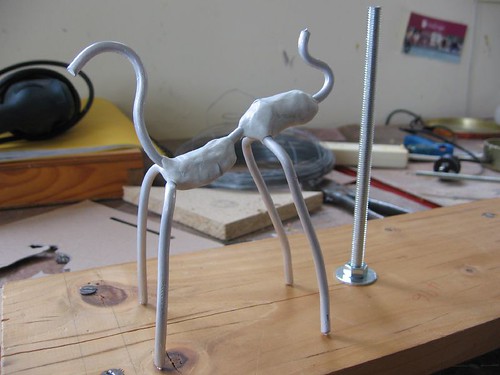
Horse sculpture

I also used wire and Knead-It to attach the armature to a firm stand. I struggle with being too impatient at the beginning of a project to go to the trouble of making a firm base like this, and I often regret it – and know I’m going to regret it, what’s more! However, I’m getting wiser about this, and decided to follow Peter’s advice, even though the horse was small.
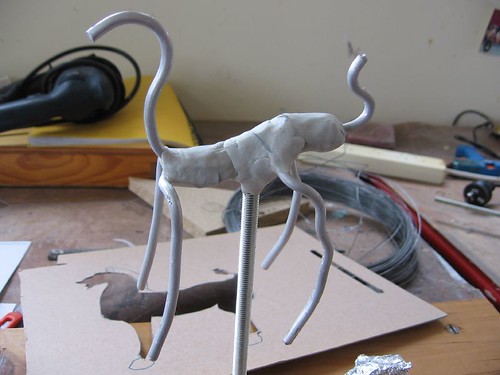
Horse sculpture

Another tip that I appreciated was to make a cardboard cutout of the silhouette of the horse to use as a reference while sculpting. I usually sculpt by eye, but this allows you to check how you are going.
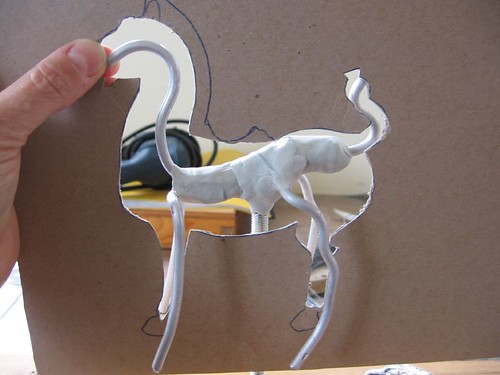
Horse sculpture

I padded out some of the bulkier parts of the body with aluminium foil, as a way of saving how much super sculpey I needed to use later. Wire is wound around the armature wires to give something for the modeling clay to grip onto.
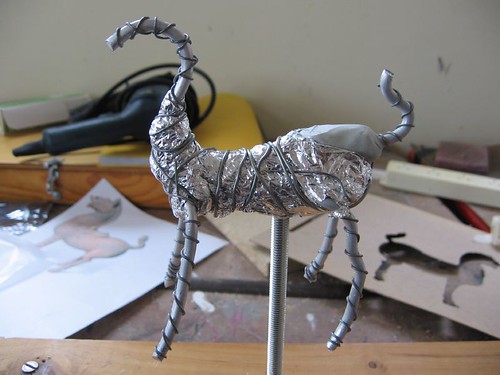
Horse sculpture

Now the best bit, the modeling! I’ve only recently started using Super Sculpey, and its a real pleasure to work with, because it remains soft for a long time and takes detail so well. Peter says to check it’s soft when you buy it, in case its been on the shelf a long time, and to keep it in a zip lock plastic bag.
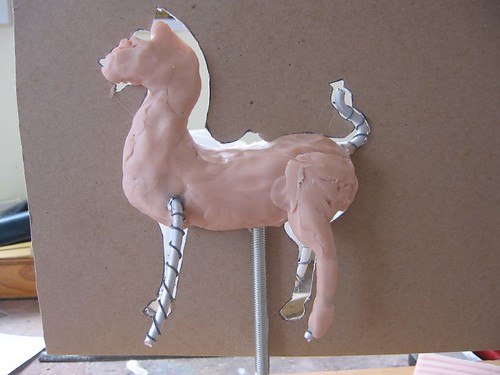
Horse sculpture

So she kneaded it and punched it and pounded and pulled till it looked okay… You can use mineral turpentine to gently bush the surface detail to smooth it, and almost model the tiny detail with the brush.

Horse sculpture

Into the oven to bake. I had trouble fitting it in my oven still attached to the stand, and ended up putting it in on its side. I thought trying to cut off the support before the horse was baked might risk the horse getting squashed. Maybe next time I should make it so it unscrews instead.

Horse sculpture

Sawing the support bolt off was a little tricky, but manageable. There were a few small cracks, but I gather this is quite common, and took Peter’s advice to fill them with sculpey and blast it for a few seconds with a heat gun, only in my case it was with a hair dryer. Instant glue is effective for mending breaks. Then, on to the second horse.

Horse sculpture

Super sculpey takes acrylic paint very well, and I used a dappled mix of greys and terracottas to get the final finish.

Horse sculptures

There are more photos here. I guess I got a bit carried away, but sometimes that just happens.
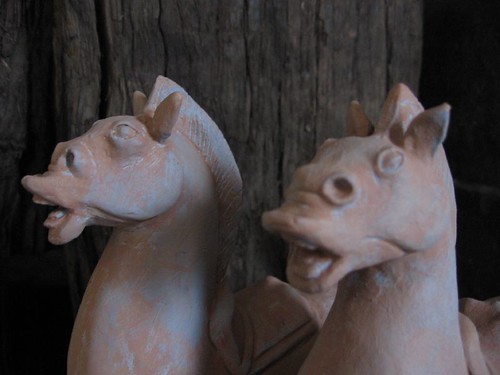
Horse sculptures

Australia & accelerating global carbon emissions

Logo_gcp

A new analysis by Global Carbon Project scientists shows that carbon intensity in the world economy is increasing. While emissions of carbon dioxide (CO2) are accelerating worldwide, we are gaining fewer economic benefits from each tonne of fossil fuel burned. A study being published this week in the Proceedings of the National Academy of Science shows that CO2 emissions increased by 1.1 % per year through the 1990s but the rate of increase jumped to 3 % per year in the 2000s.

In Can climate change get worse? it has The Age looks at the implications for Australia from the same data, quoting Dr
Michael Raupach (senior CSIRO scientist and co-chairman of the Global Carbon Project, who led the international research).

The Age: CO2 emissions speed up over 2000: study
AM: Carbon emissions rise at twice the world rate (audio interview and transcript)
SMH: Australia’s carbon dioxide emissions twice world rate

Update:

The CSIRO media release provides a summary of the Australian focus in Background: Australia’s CO² Emissions in the Global Context:

Australia, with 0.32 per cent of the world population, contributes 1.43 per cent of CO² emissions from fossil fuels. In a global context, and particularly in comparison with other developed regions (the USA, European Union and Japan), these emissions rank as follows:

    • Australia’s per capita emissions in 2004 were 4.5 times the global average, just below the value for the USA.
    • Australia’s carbon intensity of energy (amount of carbon burned as fossil fuel per unit of energy) is 20 per cent higher than the world average, and 25 to 30 per cent higher than values for the USA, Europe and Japan. Therefore, the energy efficiency of fossil fuel use is significantly lower in Australia than in these other developed countries.
    • Australia’s carbon intensity of GDP (amount of carbon burned as fossil fuel per dollar of wealth created) is 25 per cent higher than the world average. It is a little higher than the USA and nearly double that of Europe and Japan. Therefore, the overall carbon efficiency of the economy, per unit of fossil fuel used, is about half that for
      Europe and Japan.
    • Over the last 25 years, the average growth rate of Australian emissions was approximately twice the growth rate for world as a whole, twice the growth rate for the USA and Japan, and five times the growth rate for Europe.
    • The rate of improvement (decline) in the carbon intensity of GDP for Australia is lower than in the USA and Europe.

(Disclaimer: Michael is my husband)

Rambling

Orange and blue

Not sure why I thought of this photo this morning. It was taken about 18 months ago at Middleton in South Australia, and I love the washed out summer look with the orange and blue.

I had the pleasure of having lunch with fellow Canberra blogger Ampersand Duck a couple of days ago. I really enjoyed it — thanks, AD!

That day I also picked up a copy of Northern Lights, the first in Philip Pullman‘s trilogy His Dark Materials. I’ve been intending to read it since blogging about the theatrical production which featured puppetry daemons designed by Michael Curry, and now by the news that it’s being made into a film, The Golden Compass, which has a release date at the end of this year. I’ve already dived in, and I’m finding the story engrossing.

I wonder how the daemons will be done in the film?

Bent Objects

Bent

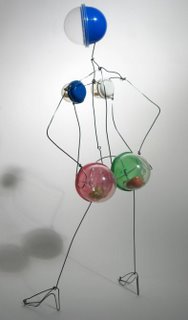
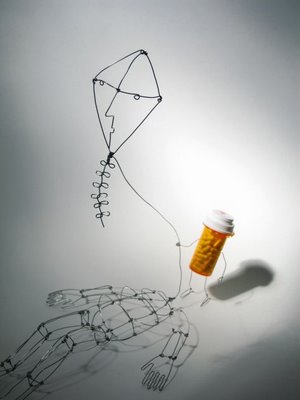
Terry at Bent Objects makes these lovely whimsical figures and scenes with wire and everyday objects. They remind me of the wire figues in Calder’s Circus, and I can imagine them being brought to life as puppetry.

Kite

(via Craft Magazine)

The Model Family

Model family kit

A 1956 family in model aeroplane kit form, Guy Bottroff’s cool sculpture The Model Family, at the Helpmann Academy Graduate Exhibition in Adelaide this last March. A few more photos here.

Model family kit

That one!

I want one of these hybrid electric bikes. Seriously.

Then there’s the George Bush Solar Powered Walking Chariot! The robotic rollerblading leg movement is very good.

(via Celcias)

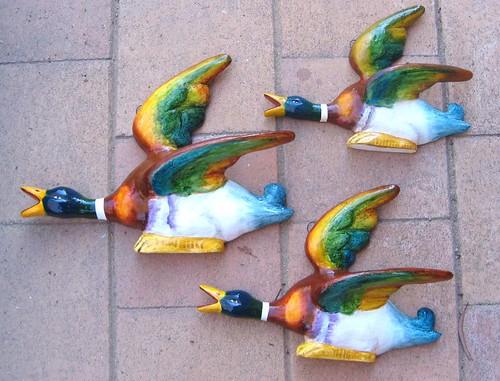
Flying ducks again

Painting

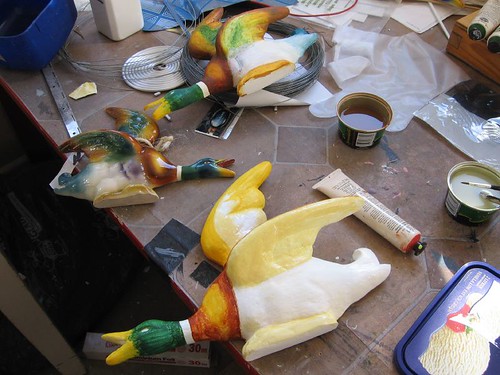
The ducks have progressed to the painting stage, and I should finish them today. When the paper mache dried fully, it somehow warped the necks and top wings slightly, so that the ducks didn’t sit flat against the wall, so I had to do a bit of surgery, making a cut in each tension point, and filling it to push the part back. I also spent quite a lot of time smoothing the surface and sanding and filing the feather shapes, as the paper mache doesn’t allow fine shaping, and dries just a little bumpy. It’s also proving tricky to get the glazed translucent look that the ceramic ducks have. I am putting a lot of hope in the final varnish!

Update:

This is how they turned out. They are for “1 in A 100”, a play about mental illness (synopsis here) written by Mary Rachel Brown, directed by Carol Woodrow, design by Imogen Keen, at Canberra’s Street Theatre in May 2007.

IMG_3780-1