 I’ve always had a feeling that the time around 1860 was a watershed in many ways. Apart from anything else it was when Darwin published his revolutionary ‘Origin of the Species’.
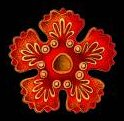
Earlier this year Scott Draves released a rendering of some of the beautiful images in Ernst Haeckel’s Kunstformen der Natur (Artforms of Nature). In these the alpha (transparency) channels in the PNG files are released under the attribution share-alike Creative Commons license, under which you can use them to composite them into other images.
Ernst Haeckel lived from 1834-1919, and became a supporter of evolution after reading the ‘Origin of Species’ in 1859, although he was more of a Lamarckian than Darwinian. In 1862 he became a professor of comparative anatomy in Jena, Germany, and in the 1860’s worked on many invertebrate groups, among them radiolarians, a group of aquatic protozoa. Kurt Stueber has made available online scans of Haeckel’s lovely Die Radiolarien drawings , and a complete index of his Kunstformen der Natur drawings. The exquisitely fine detail and natural patterns in the drawings are a delight, and the geometry always intreguing.
The drawings also made me think of several passages in Peter Carey‘s novel ‘Oscar and Lucinda’, where Oscar has to help his father, Theophilus, collect specimens of creatures from the sea, a job that he hates and fears.
‘In the sea-shells on the beach he saw the wonders which it was his father’s life to label, dissect, kill. He also saw corpses, bones, creatures dead. Creatures with no souls. When the sea lifted dark tangles of weed, he thought of jerseys with nothing in their arms.’
and later:
‘He ran, the guilty and obedient son, to help with the little creatures his father had captured, the anemones, antheas with fragile white tentacles, red-bannered dulses, perhaps a sleek green prawn or a fragile living blossom, a proof of the existence of God, a miracle in ivory, rosy red, orange or amethyst.’
Describing Oscar’s father, Carey writes:
‘Theophilus Hopkins was a moderately famous man. You can look him up in the 1860 Britannica. There are three full columns about his corals and his corallines, his anemones and starfish. It does not have anything very useful about the man. It does not tell you what he was like. You can read it three times over and never guess that he had any particular attitude to Christmas pudding.’
‘He was a dark, wiry widower of forty, hard and bristly on the outside, his beard full, his muscles compacted, and yet he was a soft man, too. You could feel this softness quivering. He was a sensualist who believed passionately that he would go to heaven, that heaven outshone any conceivable earthly joy, that it stretched, silver sheet, across the infinite spaces of eternity. … He was one of the Plymouth Brethren.’
So the stage is set for the wonderful story of how a taste of Christmas pudding leads Oscar at the age of 15 to abandon the Plymouth Brethren for the Anglican Church, and become an obsessive gambler to Lucinda’s compulsive one. Its also the story of how our lives and histories are governed largely by random incidents and circumstances. I don’t think it is any coincidence that the time-frame Carey chooses is the same as that of the emergence of Darwinism, and the religious doubts that that brought to society, stemming from the idea that we are no different to any other species: that humans, like other species, evolve and survive directly in relation to random events in their environment, rather than being subject to some divine influence.
One of the pleasures of Carey’s work, and one of his hallmarks, is the way he plays with fact and fiction. I googled to see if there actually was a naturalist called Theophilus Hopkins, and whether perhaps there was a way in which Haeckel fitted in. Instead I came up with another intrequing idea. In an essay in Gerard Manley Hopkins Online, titled ‘Gerard Manley Hopkins and Oscar Wilde – Victorians and writers’, parallels are drawn between Oscar Wilde, ‘the greatest talker of the Victorian age’, and Hopkins, ‘its most silenced poet’. It then goes on to say:
‘Peter Carey shows that the easiest way to conjoin two Victorian paradoxes is simply to combine their names: Oscar Hopkins of Oscar and Lucinda, or the devout Anglican priest with a passion for gambling. According to Norman White, Peter Carey based the Reverend Oscar Hopkins partly on Gerard Manley Hopkins; Oscar’s father is the Rev. Theophilus Hopkins; Gerard’s father, Manley, used Theophilus as a nom-de-plume.’
I don’t know if this is in White’s book ‘Hopkins – A Literary Biography’ (Clarendon Press, Oxford. 1992) or elsewhere. It would be great to follow it up and see if there is more information available. Was Gerard’s father a naturalist, or did Carey invest some Haeckel in his character?
As a sculptor of organic geometrical forms, George W. Hart has been inspired by Haeckel’s artwork.
Haeckel’s theory that ontogeny recapitulates phylogeny, that foetuses step through their evolutionary history in the womb, is still controversial in the evolution/creation debates. As an aside, its intreguing how often when I am carving a puppet creature, its face passes gradually through different stages, appearing like numerous other creatures before finally becoming the one which I am working towards. The experience gives the decided impression that we are related to other creatures in ways that we may not be aware of.
 Amazon UK has a couple of copies of the book