July’s Month of Softies: Sock Monkey

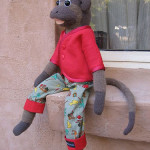
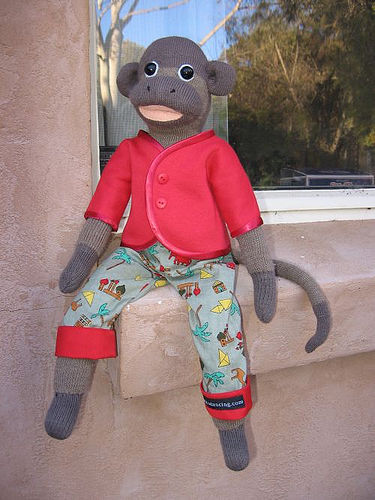
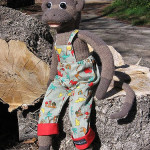
This is my submission for Loobylu’s July’s Month of Softies, a sock monkey. I’ve been curious about sock monkeys since first reading about the tradition a year or two ago, so I’m glad to have tried it out. This one started out plain and ugly, and I nearly abandoned him altogether, but I kept going back and reshaping bits. Now he is more refined, and I have grown quite fond of him.

Sock monkey-4

Here are a few more pictures of him:

Green Cape Lighthouse

Green Cape Lighthouse in Ben Boyd National Park, on the south coast of New South Wales. Built in 1883.

Two other photos here and here.

Cloning yourself; well kind of…

Happened across Duct Tape Rachel, a bold photo of the process of making a self-form-fitting duct tape dressmaker’s dummy. It links to an article called Clone yourself a Fitting Assistant by David Page Coffin, which in turn shows you four ways of making your own dummy:

Speaking of Carpets

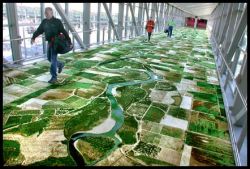
Flyingcarpet1_1I do love public and community artwork! A few days ago the Wooster Collective pointed to the public art of Seyed Alavi. There are lots of great projects to browse through, but the Flying Carpet, an aerial view of a 50 mile stretch of the Sacramento River translated into woven carpet, which was made for a pedestrian bridge at Sacramento International Airport, is extra cool.

I also like What do you think? and Solitude.

David D. Schwartz has an interest in casino landscapes, and has a fine gallery of casino carpets (updated link to Wired article 2015). The Treasure Bay carpets make me smile thinking what might have been done with the old Pemberley site map.

I’m meandering now, but you also ought to check out the miraculous Peace Rug. Don’t miss the picture page. Lets ship one to our world leaders! (update: links no longer exist)

Stencilling Carpet

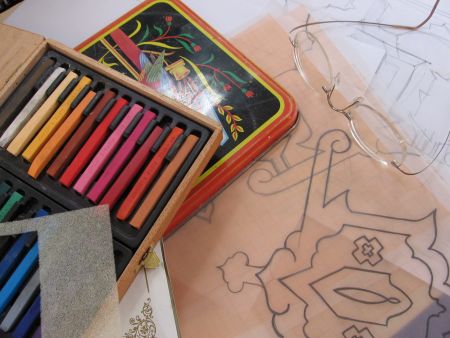
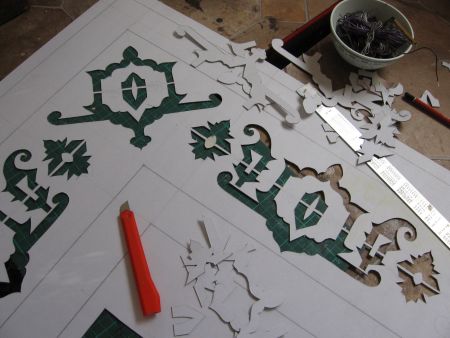
My husband’s grandfather had a wide notion of what might be fixed with paint, and it got more extensive as he got older, until he was happily fixing stains in upholstery and carpets with dabs of paint. I’ve been thinking about him today, because I have been spraypainting a border pattern onto a large piece of carpet which is to be used in a play. The design was cut as a stencil:

Stencil design

Stencil cutting

Moss graffiti and secret worlds

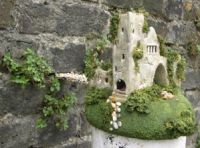
mosscastle

We have been deep in drought for some years, but in just the last few weeks we have had enough rain to encourage small patches of green to peep through, and suddenly there are beautiful verdant mounds of moss appearing in nooks and cracks in the pavement, and around trees in the gardens. I’m beginning to think I might be able to experiment with this recipe from Stories in Space for getting moss to grow in specific areas:

Recipe:
(serves to create several small pieces or 1 large piece of graffiti)
1 can beer,
1/2 teaspoon sugar
several clumps garden moss
Plastic container with lid, blender, paintbrush

‘To begin the recipe, first of all gather together several clumps of moss (moss can usually be found in
moist, shady places) and crumble them into a blender. Then add the beer and sugar and blend just long enough to create a smooth, creamy consistency. Now pour the mixture into a plastic container.
Find a suitable damp and shady wall on to which you can apply your moss milkshake. Paint your chosen design onto the wall (either free-hand or using a stencil). If possible try to return to the area over thefollowing weeks to ensure that the mixture is kept moist. Soon the bits of blended moss should begin to re-couperate into a whole rooted plant – maintaining your chosen design before eventually colonising
the whole area.’

I love the other images and ideas at Stories in Space, in particular Myrmidon Castle (pictured above), and Hideaway.
Ronnie Burkett’s Paper Mache Recipes and other things

Having seen Ronnie Burkett‘s amazing Tinka’s New Dress in its last season at the Melbourne Festival in 2002, and heard him speak so inspiringly at the Puppetry Summit there at the same time, I was interested to see Burkett’s article on paper mache (via Puppetry News and Views).

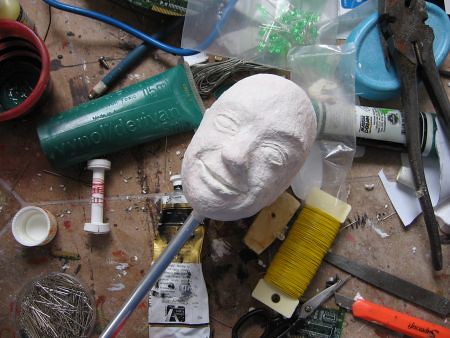
The article talks about recipes for making one’s own paper mache pulp, and the various situations they are useful for, but Burkett also says that much of the time he now uses a commercial papier mache pulp called Celluclay. I thought it would be ideal for a court jester’s marrotte that I was making, but its hard to come by here, so I tried Mix-It, which is made in Victoria. When I tried an instant paper pulp before many years ago, it was quite lumpy, but this mix turned out to be nice and smooth to work, and dried really hard and white.

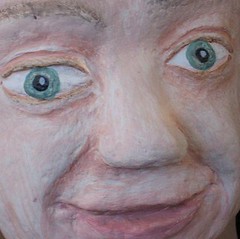
Marrotte
The head was sculpted over a wood and polystyrene base, so that the layer of paper mache is relatively thin, which has the advantage of taking less time to dry, and being economical. It’s also non-toxic and takes paint and finishes of all kinds.I did like reading that Burkett also suffers from impatience waiting for casts to be ready and things to dry.
Marrotte

I don’t see no lettuce!

Last week my son and I cracked up when we happened across a video clip of Bud Light’s Real Men of Genius: Mr Giant Taco Salad Inventor (‘I don’t see no lettuce!’).

I had no idea it was part of a series of Bud Light commercials but yesterday my friend Amy serendipitously blogged about a collection of them. I just love them! (2015 updated link)