Mummenschanz to tour Australia!

MummenMummenschanz, the renowned Swiss mime and object theatre group, will perform the world premiere of their new program, 3×11, a 33 year retrospective of their work, at the Sydney Theatre in Walsh Bay on 31st January 2006. The season runs till 11th February, 2006. Afterwards they tour Australia, New Zealand, and South America, where on 12th April they will open at the International Festival in Bogota, Colombia.

Bookings on 9250 1999 or Ticketek 132 849.

I’m wondering if I saw them long ago at the Adelaide Festival of Arts? Did they ever perform there? I know I saw them on The Muppet Show.

Updated links 2015

Big West Festival

BigwestIf you are in Melbourne, The Big West Festival in Maribyrnong looks as if it will be a good time. Full program details are available here.

For puppetry fans it’s a chance to catch Snuff Puppet’s Nyets Nyet’s Picnic; Men of Steel, a high energy cookie cutter kitchen puppetry extravaganza; the disturbing crocheting that is Foxy’s House of Horror; and others.

The venue is the Village (the Village Railway Reserve behind Footscray Station, McNab Ave, Footscray). Entrance will be free during People’s Day
on Saturday from 1 – 7.30 pm.

Look Both Ways: Sarah Watt’s animations

Lookbothways

(Image from Dendy Films)

I’m delighted the movie Look Both Ways did so well at the Australian Film Awards this weekend, taking out Best Film (Bridget Ikin), Best Direction (Sarah Watt), Best Original Screenplay (Sarah Watt), and Best Supporting Actor (Anthony Hayes).

Its a real gem: everyday, quiet, low key and unpretentious, but deals in subtle and intense ways with life and death and the things in between. Sarah Watt says: “I try and say things like it’s a romantic comedy. But unfortunately I have a tendency to look on the blacker side of life, so I suppose it’s a romantic comedy about fear, maybe, with a little death thrown in.” She has also said “I guess it’s a thing of feeling like you’re extremely fortunate, but with an awareness of how many troubles there are in the world and figuring out how to live with that fortune, whilst not stomping on the heads of those less fortunate. That’s a line that a lot of Australians have to tread daily.”

Look Both Ways is set in Adelaide, where I grew up, and it’s always fun to see familiar places in movies, especially when it doesn’t happen very often. (Shine was the last time for me). Most of the filming was done down towards the port, and the sense of atmosphere, light, dryness and heat haze was absolutely recognizable as a stinking hot Adelaide heatwave.

Another striking feature is the short animations which were done as a collaboration with Emma Kelly (from Tantalus Interactive) and Clare Callinan:

‘Animator Emma Kelly (who collaborated with Sarah on her shorts) drew all the cells over several months. Each drawing was scanned and printed onto suitable water-absorbent paper. Sarah then hand-painted all the ‘watery’ sequences, and Clare Callinan (again a previous collaborator) painted the other sequences, with Sarah finishing each painting. All the painted cells were then re-scanned at Iloura Digital Pictures in Melbourne, camera moves were resolved, and the sequences were recorded out onto 35mm, for integration into the film.’

The animations represent the internal lives of the two main characters. In accordance with their professions, Meryl’s are painterly, and represent her often fearful thoughts (clips (1, 2), while Nick’s are more photographic montage and are visual memories of his life (just a taste in this trailer). There are a couple of other trailers on the LBW site.

I came across another of Watt’s animations online. It’s from a twenty-three minute animation The Way of the Birds, based on a book of the same name by Meme McDonald. It tells the story of the Eastern Curlew:

‘After breeding and nesting in the Siberian grasslands, the adult birds migrate south again within a month or so, leaving their chicks there in the tundra. When they are less than eight weeks old, the chicks make the 13,000 km migration across the world to parts of Australia and Aotearoa/New Zealand all on their own.’

There are also animations by Watt in an associated online documentary about the Eastern Curlew, A Year on the Wing.

Updated 2015: broken links. Sarah Watt died in 2011.
Mapping puppeteers and makers

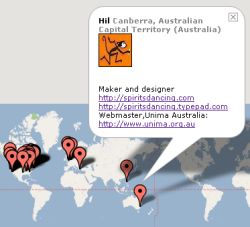
Andrew at PuppetVision is has started a map of the locations of puppeteers and puppet builders around the world using the new Frappr! mapping service. It’s a cool idea. If you are a puppeteer or maker, check out the details, and add yourself to the map.

Lone

Especially if you are in Australasia – I’m feeling a bit lonesome out here all on my own!

The Theft of Sita

Sita

(Photograph: Julian Crouch)

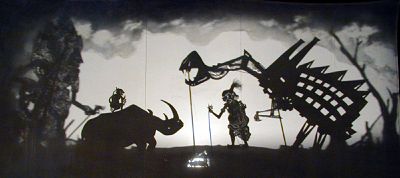
PuppetVision recently referred to The Modern Shadow where Michelle Zacharia is exploring combining Indonesian Wayang Golek puppetry and video and digital production techniques, and thinking about western influences in Indonesia. It reminded me of a production here called The Theft of Sita which was commissioned by the 2000 Adelaide Festival of Arts and received acclaim both here and overseas. It was a modern retelling of the Ramayana using shadow puppetry, and involved a remarkable collaboration of artists, puppeteers, makers and musicians.

The piece was written and directed by Nigel Jamieson (AU); music composed by the Australian jazz musician Paul Grabowsky (AU) and Balinese gamelon artist I Wayan Gde Yudane; designed by Julian Crouch (UK); and the puppetry directors were Peter J. Wilson (AU) and Balinese master I Made Sidia (who both performed in the show).

This Ramayana begins conventionally, but quickly explodes into a metaphor of the tumultuous events surrounding the overthrow of Suharto. Computer-generated images and photographic projections of demonstrations coexist with giant shadow puppet logging beasts. There are white water rafters and withering paddy fields in Bali. And Langka becomes a futuristic city of gleaming steel and glass towers, and of rubbish tips. Giant screens lift and disappear, perspective shifts from screens at the front to screens at the back of the stage. Shadow puppets emerge on tiny screens in the middle of the space and then shift again.

Robin Laurie, Inside Indonesia, The Theft of Sita

Robin’s article is worth reading in full, as is Peter Wilson’s account in his book ‘The Space Between: The Art of Puppetry and Visual Theatre in Australia’, where he describes The Theft of Sita as a transformation of the ancient tale into a modern allegory of environmental politics.

Unfortunately I didn’t see The Theft of Sita, but I have seen a TV program that was made about it.

The designer, Julian Crouch, has a gallery showing some of the wonderful shadow puppets and scenes from the show, including the one above. His other galleries have some gems in them, too. Just a couple of examples: a dog, some huge figures, and some rather beautiful arresting star faces.

Update 2015: broken links; also, try a Julian Crouch google image search

Insanely Twisted Shadow Puppets

TwistedMichael Gagne recently released a first series of short director’s cuts animations, Insanely Twisted Shadow Puppets, that he created for Nickelodeon’s 2005 Halloween. For example, Nightmare is great. There is a short production diary, too. These are done in Flash, and looking at them it’s easy to see why puppetry and animation are so closely inter-related.

(via PuppetVision)

Cartoon Skeletal Systems

betty_boop

This is a cool idea: Michael Paulus has a gallery which takes a look at the skeletal systems of cartoon characters. The distortions are interesting. For example, Betty Boop has no lower jaw!

(Via Drawn!)

Updated links 2015

Snort! : nonsense regarding The Pig

The moniker for the new adaptation of Pride and Prejudice is likely to be ‘the Kiera Knightley version’, but I am going to campaign for ‘the one with the pig’ until someone does a Wishbone-type adaptation with Babe animatronic technology (starring the pig) or puppet pigs (move over Miss Piggy, I don’t want a Muppet version!). I’m amused by the fuss the pig is causing – ‘It shouldn’t be in the house’ – ‘How many times must I explain it’s not in the house’ – ‘It’s too rural and makes the Bennets seem too poor’ – because I suspect the distaste probably stems more from the implication intended by juxtaposing the stud pig with Mrs Bennet gloatingly sending Jane over to Bingley at Netherfield:

iW: Then you have this pig walk by and he has enormous balls.

JW: That’s not something we thought of before we saw the pig. Then when we met the pig, we were incredibly impressed by him. I’m rather interested in the fact that a family like the Bennets would only own female pigs. They’d hire the male pig to come in and, as they call it, cover the sows, at a fee. I kind of liked the parallels between human and animal procreation.

Joe Wright, Director

This rather puts new life into a rather jaundiced cartoon I did a few years ago:

Snort!

The only other Austen cartoon I made was this one of Charlotte shrewdly eyeing off Mr Collins:

All your base

Of course you could add cartoon bubbles to the pictures in the Jane Austen Colouring Book.

Ping pong Matrix style

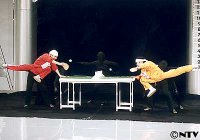
MatrixHere is a fabulous game of ping pong, Matrix style. According to Puppetry Films, it appeared on a Japanese Game Show to help celebrate the opening of the Matrix. Isn’t puppetry amazing?

Updated links 2015